
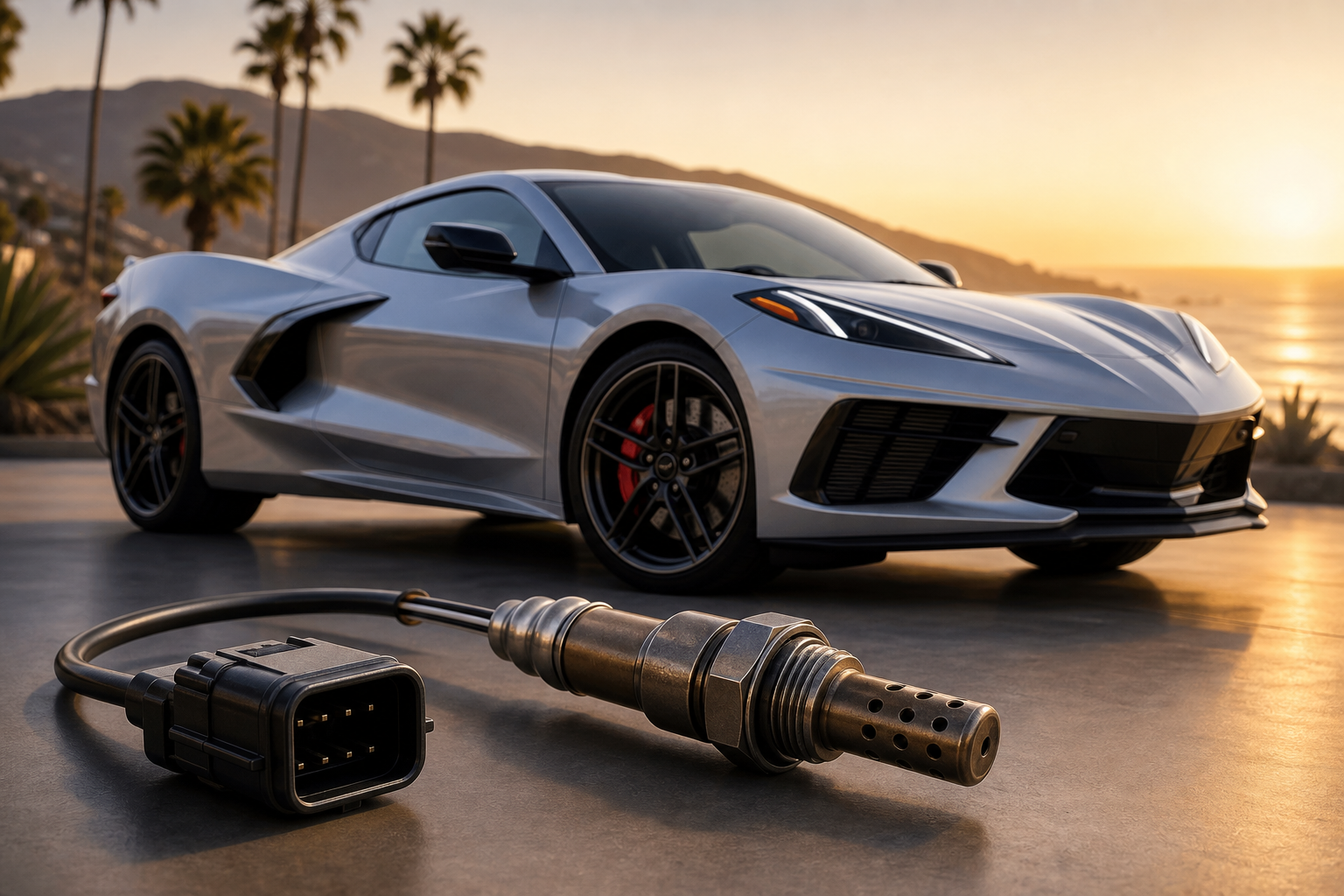
O2 Sensor Not Ready on Your C8 Corvette: A California Owner’s Guide to OBD-II Readiness Monitors
Seeing “O2 Sensor Not Ready” on a scan tool when your car has fewer than 400 miles on it feels like something went wrong at the factory. Nothing did — but understanding what this status means, and what California actually requires for a 2024 vehicle registration, changes the whole picture.
If your C8 is a 2024 model, you may not need to worry at all
California exempts vehicles from smog inspections for the first eight model years. A 2024 Corvette won’t need its first mandatory OBD smog check until the 2032 registration renewal cycle. During those eight years, the state collects a smog abatement fee in place of the inspection. So if this is a new car being registered in California for the first time, the O2 monitor status is irrelevant to getting your plates.
There are situations where you might still need monitors to be ready: converting an out-of-state title to California, or a private-party purchase where a smog certificate was required before the sale. If that’s your situation, the rest of this article is for you.
What OBD-II readiness monitors actually are
Every car built after 1996 has an on-board diagnostic system that continuously monitors emissions-related components. The system runs a set of self-tests called readiness monitors — routines that check oxygen sensors, catalytic converter efficiency, the evaporative emissions system, fuel trim, misfires, and more.
These tests don’t run constantly. Each one requires specific driving conditions to trigger — a cold start here, a sustained highway cruise there. Until those conditions occur and the test completes, the monitor shows as “not complete” or “not ready.” On a car with 340 miles that’s been delivered, prepped, and driven gently around a lot, many of those conditions may never have been met.
A battery disconnect — routine during pre-delivery inspection — wipes all monitor history, resetting everything to not ready. That’s the most likely culprit on a brand-new car.
California’s current smog check rules for OBD monitors
For years, California allowed one incomplete monitor (the EVAP system was the common exception) for 2000-and-newer vehicles to still pass a smog check. That changed. Effective October 1, 2025, updated Bureau of Automotive Repair regulations require all applicable readiness monitors to show complete for any OBD-equipped vehicle to pass. The one carve-out: a documented, BAR-approved design-related issue — not something that applies to a stock Corvette.
For a 2024 model, none of this is relevant yet. When 2032 comes around and that first smog check is due, every monitor will need to be set.
The GM drive cycle for setting the O2 sensor monitor
GM publishes a specific drive cycle for completing OBD-II readiness monitors. The O2 sensor monitor is one of the more demanding ones — it needs a true cold start, a specific idle phase, and a sustained highway cruise before the ECU will log it as done. Here’s the sequence.
Starting conditions
- Engine coolant temperature must be below 50°C (122°F) — a genuine overnight cold soak, not just a brief cool-down between runs
- Coolant temp should be within about 11°F of the ambient air temperature
- Fuel tank between one-quarter and three-quarters full
- Do not switch the ignition on before cranking — sitting key-on before starting can prevent the heated O2 sensor test from running at all
Step 1: Cold-start idle with climate loads on
Start the engine from cold. Turn on both the A/C and rear defroster, then let the engine idle for about two and a half minutes without touching the throttle. This phase tests the oxygen sensor heater circuits — the ECU checks whether the heaters are warming the sensors up to operating temperature before exhaust heat does the job.
Step 2: Accelerate to highway speed
Switch off the A/C and defroster. Accelerate at moderate throttle — roughly half-pedal — up to 55 mph. A normal highway on-ramp pace is exactly right. Don’t floor it and don’t crawl.
Step 3: Sustained cruise at 55 mph
Hold a steady 55 mph for at least three minutes. This is the critical phase. The ECU is checking O2 sensor response time, air-fuel ratio correction behavior, and fuel trim during a stable load condition. On the C8, using paddle-shift manual mode to lock yourself in the right gear keeps engine speed in the target range without hunting between gears.
Step 4: Deceleration
Release the throttle and coast down to around 20 mph without braking if traffic allows. This triggers the deceleration fuel cutoff test.
Step 5: Final cruise and stop
Accelerate back to 55–60 mph, hold for a few more minutes, then coast to a full stop. The full cycle takes around 20 to 30 minutes from a cold start.
After the cycle, check monitor status with a scan tool or an OBD-II Bluetooth adapter paired to a smartphone app. The O2 sensor monitor should show complete. If it still reads not ready, repeat — some monitors need two or three correct runs before they log as done.
When the monitor still won’t set after multiple attempts
Repeated failures almost always come down to one of three things.
- Not a genuine cold soak. Back-to-back cycles without an overnight cooldown don’t satisfy the starting temperature threshold. Let the car sit until fully cold before the next attempt.
- A stored fault code. An active DTC blocks certain monitors from running. Scan for codes first, address whatever triggered them, clear them, then retry the drive cycle.
- Battery condition. A low or marginal battery can interrupt a monitor mid-run. Confirm the battery is fully charged before starting.
An actual O2 sensor failure at 340 miles would be unusual — not impossible, but unlikely on a brand-new car under warranty. If multiple correct drive cycles produce nothing and no fault codes are present, a dealer visit with factory-level scan tools will show exactly which enable condition isn’t being met.
Sources
- bar.ca.gov
- dmv.ca.gov
- bar.ca.gov
- blog.smogcheck.com
- obd-codes.com
- corvsport.com
- xerodrive.com
- justsmogs.com