Best Front Splitters and Lips in 2026: What Independent Reviewers Actually Say
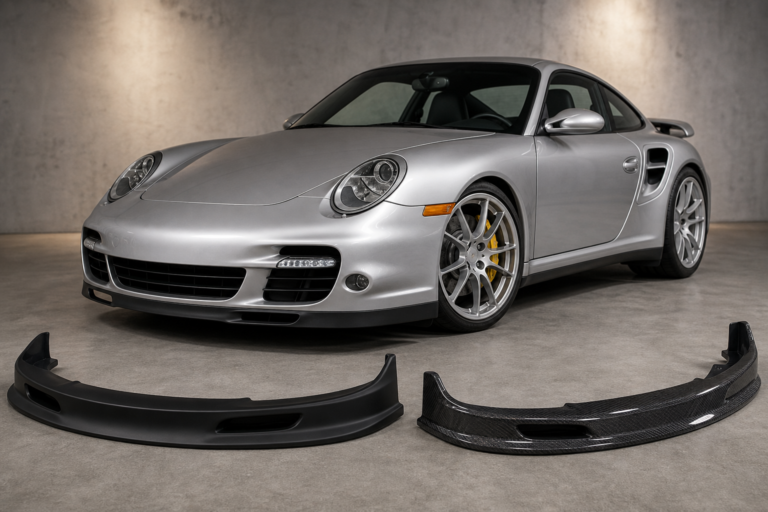
Most people shopping for a front splitter or lip end up confused by the naming. They’re not the same thing, the price gap is enormous, and the aerodynamic claims range from legitimate to marketing fiction. Here’s what independent reviewers and owners across multiple platforms actually found.
The short version
For a street car, a model-specific polyurethane or ABS lip from a brand like Maxton Design gives you the look at reasonable cost — expect fitment quirks and some durability compromise. For a track car that genuinely needs front-end grip, the technical community around Occam’s Racer and Nine Lives Racing is consistent: only a rigid, properly mounted splitter with an undertray does measurable work. Universal peel-and-stick options (EZ Lip, All-Fit) are bumper protectors with cosmetic upside — nothing more. APR Performance and Revozport sit at the premium end; the quality is real, but so is the price.
Products at a Glance
| Product | Material | Best For | Price (approx.) | Sourced From |
|---|---|---|---|---|
| EZ Lip PRO | Closed-cell foam | Budget cosmetic / bumper protection | ~$35 | EZ Lip blog; Amazon customer reviews |
| All-Fit Universal Lip Kit | Solid rubber | Cosmetic; non-leased daily drivers | ~$60 | All-Fit Automotive blog; Fiesta ST Forum |
| Maxton Design Model-Specific Splitter | ABS plastic | Street style; mild aero intent | Varies by model | Fiesta ST Forum; Baby BMW Forum; Audizine |
| APR Performance Front Wind Splitter | Carbon fiber (+ Nomex honeycomb option) | Track and performance builds | From ~$639 | APR Performance; SMY Performance; AmericanMuscle |
| Nine Lives Racing Custom Splitter Kit | Composite / customer-specified | Dedicated track use; GR86, Miata, BRZ | Varies | 9livesracing.com; Enjuku Racing; FT86CLUB |
| Revozport Model-Specific Carbon Lip / Splitter | Carbon fiber | Premium street and track BMW, Audi | $939 (lip) – $4,255 (full splitter) | Revozport; IKON Motorsports guide |
What the reviews agree on
Material determines use case, not brand
Every independent source — from Revozport’s buyer guide to IKON Motorsports’ breakdown — reaches the same conclusion on materials. Polyurethane and ABS absorb scrapes and flex over obstacles; they’re the sensible call for a car that sees parking garages, steep driveways, and variable road surfaces. Carbon fiber is rigid and light, which is exactly what you want at speed, but it shatters on kerb strikes. Aeroflow Dynamics puts it plainly: front lips with flexible construction are best suited to daily drivers, while rigid splitters serve performance-focused builds.
A lip without an undertray does very little aerodynamically
This is the technical consensus that most marketing copy quietly ignores. The engineering community at Occam’s Racer is blunt: a front lip that isn’t connected to a rigid horizontal undertray creates a negligible low-pressure zone underneath the car, and therefore negligible downforce. The same source documents that a well-designed splitter at 6 inches of ground clearance can generate over 100 lbs of front downforce, reaching roughly 250 lbs near 1.5 inches — but an unsupported chin spoiler achieves a fraction of that. IKON Motorsports echoes this, noting that front lips offer “style and mild aero” rather than genuine performance gains.
Fitment quality separates good brands from bad ones
Forum threads across Fiesta ST Forum, Baby BMW Forum, and Audizine all stress the same point: even an adequate design looks wrong if the panel gaps are off. Owners repeatedly flag that model-specific parts — whatever the brand — consistently outperform universal kits on fit. Nine Lives Racing’s custom-template approach is praised in the GR86 and Miata communities specifically because it eliminates guesswork entirely.
Where they disagree
Is Maxton Design worth it?
Maxton Design is the most-discussed mid-market brand across English-language forums, and opinions split hard. On Baby BMW Forum, some owners report clean installation and solid appearance for the money. On Fiesta ST Forum, the picture is messier: owners running US-spec cars found the European-designed splitter required cutting the side extensions and drilling additional mounting holes to avoid damaging OEM plastics. One owner noted the hollow, ribbed internal construction felt “flimsy” compared to solid-section ABS alternatives. The consensus seems to be that Maxton is fine if your car is a European-market model with a direct-fit variant — and risky if it isn’t.
EZ Lip vs All-Fit: which universal kit holds up?
EZ Lip and All-Fit have been the dominant budget options for years, and the debate about which holds up better is genuinely unresolved. EZ Lip’s closed-cell foam conforms to almost any bumper shape and installs in minutes with no drilling; at $34.99 it’s the lower-risk entry. All-Fit’s solid rubber costs $59.95 and is demonstrably more rigid — but installation requires V-cuts at corners, self-tapping screws, and drilling into the bumper, making it a permanent modification. Amazon customer reviews flag adhesive failure for the EZ Lip in highway use, while All-Fit’s drilling requirement draws complaints from anyone on a lease. Neither brand disputes the other’s characterisation; EZ Lip’s own comparison blog openly acknowledges it sacrifices durability for ease.
Do front splitters actually make a difference on the street?
Track builders say yes, with caveats. Street users are much less certain. The Occam’s Racer technical post — one of the more analytically rigorous sources on the subject — argues that most aftermarket splitters marketed to street drivers are missing the design features (rounded leading edge, full undertray seal, correct ride height) that make the aero work. A Fiesta ST owner who installed a Maxton splitter described smoother highway feel but admitted it “might be all in my head.” APR Performance, by contrast, explicitly designs its carbon wind splitters with a “fully functional undertray” to generate measurable downforce — and sells the product primarily to performance and track builds, not commuters. That distinction matters.
Budget carbon-look vs real carbon fiber
Rexpeed and APR sit at opposite ends of the genuine carbon fiber market — Rexpeed’s JDM-platform splitters (Evo X, GRB STI, MK5 Supra) use high-gloss clear-coated 2×2 twill weave, test-fitted before shipment. APR adds a Nomex honeycomb core option for maximum stiffness-to-weight at higher speeds. Both are categorically different from the “carbon fiber look” ABS or cheap wet-lay parts that flood online marketplaces. Multiple sources flag that inexpensive carbon-look parts use ABS with a carbon-print film; they weigh the same as regular plastic and offer none of the rigidity benefits.
FAQ
What’s the actual difference between a front lip and a front splitter?
A front lip attaches to the lower edge of the bumper and curves downward, following the bumper’s shape. Its primary role is visual. A front splitter is a flat horizontal plane that extends forward from the bumper, supported by rods or brackets, designed to separate airflow above and below the car’s nose. Revozport’s buyer guide summarises it well: “structure matters more than naming” — a sufficiently extended, rigidly mounted lip functions aerodynamically as a splitter, while a nominally labelled splitter with no undertray does not.
Which material is best for a daily driver?
Polyurethane and ABS are the practical choice. Both flex on contact rather than shattering, and ABS in particular offers good UV resistance. Carbon fiber is expensive, brittle, and difficult to repair if you clip a kerb or a speed bump at an angle. IKON Motorsports’ buying guide calls a quality ABS or urethane lip “the safest and most versatile option for most drivers.”
Will a front lip affect fuel economy or cooling?
At street speeds the aerodynamic effect on fuel economy is negligible — changes would be within measurement noise. Cooling depends heavily on the specific design: a splitter that channels air toward the radiator intake improves it; one that blocks the lower grille opening could have the opposite effect. APR Performance notes that its undertray designs direct airflow toward brake and radiator cooling ducts, but this is a characteristic of specifically engineered performance parts, not off-the-shelf universal lips.
Can I install a front splitter without drilling?
Depends entirely on the product. EZ Lip is fully adhesive, no drilling required, and can be removed without permanent damage — which is why it’s popular on leased vehicles. All-Fit requires screws and drilling. Model-specific ABS splitters like Maxton Design’s range use a combination of existing bumper holes and supplementary self-tappers. Full carbon fiber performance splitters from APR or Revozport typically require more involved mounting with dedicated rods and brackets; installation difficulty rises with aero ambition.
Do I need splitter rods?
For anything beyond a cosmetic lip, yes. Occam’s Racer’s technical analysis shows that a flexible or poorly-supported splitter loses effectiveness quickly under aerodynamic load — the part deflects upward under downforce instead of transferring it to the chassis. Nine Lives Racing and APR both include rod or bracket hardware with their performance-oriented kits for this reason. Skipping the rods on a track car is a false economy.
Sources
- occamsracers.com
- revozport.com
- ikonmotorsports.com
- aeroflowdynamics.com
- ezlip.com
- fiestastforum.com
- allfitautomotive.com
- 9livesracing.com
Related Articles