
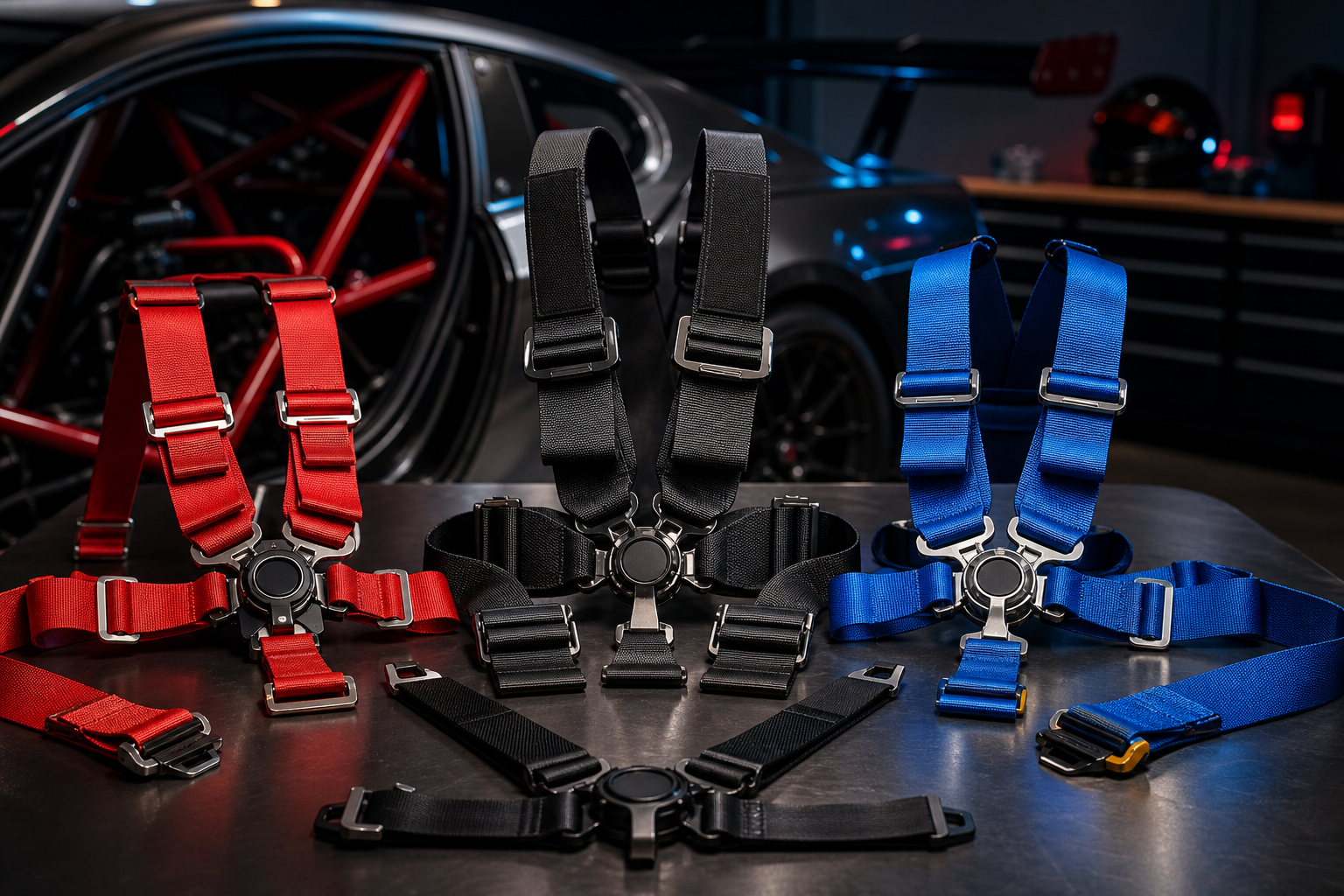
Best Racing Harnesses in 2026: What Experts and Owners Actually Recommend
A racing harness is one of those purchases where getting it wrong has real consequences — a failed tech sheet or a belt that moves when it shouldn’t in a crash. Here is what independent expert sources and long-term owners actually say about the options in 2026.
The short version: For endurance and club racing, Sabelt and Schroth split the top of nearly every roundup, with track-day owners increasingly preferring Sabelt’s adjuster design. For street and HPDE use without a cage, the Schroth Profi II ASM is the best-argued 4-point option. Lifeline and TRS offer legitimate FIA-approved alternatives at prices that undercut the German and Italian leaders by a meaningful margin.
What the reviews agree on
Across every source consulted — from BimmerWorld’s detailed buying guide to the long owner threads on Rennlist — certain points land without argument.
FIA 8853-2016 is the target certification. BimmerWorld’s harness buying guide is explicit: FIA belts are valid for five years from the date stamped on the tag, and any sanctioned road racing series will require it. SFI 16.1 satisfies most drag and oval organisations but is not accepted at FIA or NASA-affiliated events. Both standards mean the belt passed crash testing; they serve different rulesets, not different safety philosophies.
Six points beat four in competition. The dual sub-straps on a 6-point prevent submarining — the body sliding forward and under the lap belt during a frontal impact. Track-First’s safety restraint guide and BimmerWorld both flag this as the decisive argument for any car with a roll structure. All five of TopTenReviewed’s top picks are 6-point designs for exactly this reason.
Two-inch shoulders, not three, if you run a HANS device. BimmerWorld states this clearly: a 3-inch shoulder strap cannot physically mate with a head restraint. If a HANS or FHR device is mandatory in your series — increasingly common in club racing — the shoulder belt width is not cosmetic.
Roll structure comes first. Every expert source repeats this. Competition belts lock the driver rigidly in place; without a roll cage or bar, a rollover becomes fatal. BimmerWorld notes that straps must sit squarely over the seat back and collarbone area, and that stock reclining seats make correct geometry impossible. A proper racing seat is not optional.
Schroth, Sabelt, and OMP dominate the credible premium tier. Whether you read TopTenReviewed’s structured roundup, Track-First’s curated price guide, or the veteran threads on Rennlist, those three names appear at the top of every list. Sparco and Lifeline round out a credible mid-tier. Budget entries from NRG and Zamp appear in Track-First’s catalogue but generate almost no positive owner commentary in specialist forums.
Where they disagree
This is the useful part.
Sabelt versus Schroth. TopTenReviewed ranks the Schroth Profi II-6 first, citing its safety features and adjustability. Rennlist’s long-running enduro thread tells a different story: experienced racers report the Schroth Enduro loses tension through a stint while the equivalent Sabelt holds firm. Owners on that thread praise Sabelt’s lap adjusters positioned “right on the buckle” — critical for a driver tightening solo while already strapped in — alongside velcro tabs that prevent shoulder straps from falling behind the seat between stints. At $999 for the Sabelt Enduro Gold against $860 for the Schroth Enduro 2×2 (both sourced from Track-First), the premium buys an adjuster system that forum veterans consistently rate as superior.
Is Lifeline just a cheaper Schroth? Multiple Rennlist contributors describe Lifeline’s hardware and mechanisms as functionally identical to Schroth at roughly two-thirds the price — the Lifeline Copse at $499.99 versus the Schroth Enduro at $860. BimmerWorld’s guide lists the Lifeline Becketts ($369.99) and Copse ($499.99) approvingly as fully FIA-certified alternatives. Schroth advocates argue brand support and manufacturing consistency justify the difference. Lifeline owners say they cannot find a gap in real-world track use. Racequip also gets a mention in the same Rennlist thread as a similarly priced option with “very similar” mechanisms to Schroth.
4-point belts on the street: safe compromise or net downgrade? BimmerWorld notes that 4-point belts without anti-submarining technology demand a roll structure just like a 6-point. The Schroth Profi II ASM — around $376 at GSM SportSeats4u — uses a patented mechanism to resist forward slide without sub-straps, and BimmerWorld endorses it for street and HPDE use. Some Rennlist members take the opposite view: any belt lacking sub-straps is worse than a factory unit in a road crash. The practical consensus in scrutineering forums is that the ASM 4-point, combined with a proper racing seat, is the belt most tech officials will pass for HPDE without a cage. For road-only driving, the stock belt wins.
TRS versus the continental brands. TRS Motorsport, a UK manufacturer in operation since 1989, is positioned by GSM SportSeats4u as a legitimate challenger to Sparco and OMP in the lightweight 4-point segment. The TRS Magnum Ultralite at around £306 ex VAT carries FIA and ECE approval with alloy adjusters on both lap and shoulder straps. Continental forum users rarely mention TRS; UK club racers rate it highly. This reflects a genuine geographic difference in brand penetration rather than a quality gap.
Budget brands: compliant but community-untested. Track-First lists the NRG FIA 6-point at $275 and Zamp’s camlock from $234. GSM SportSeats4u notes the QMS 4-point at £165 as an entry point into FIA compliance. A valid FIA tag means these passed standardised crash tests — nobody calls them unsafe outright. What specialist forum owners at Rennlist and Track-First flag is hardware durability over multiple seasons: adjuster wear, camlock feel, and strap retention. For a driver exploring whether circuit work is for them, an FIA-certified budget belt is a defensible starting point.
Best Racing Harnesses in 2026: Comparison
| Model | Type | Cert | Approx. Price | Best for | Sourced from |
|---|---|---|---|---|---|
| Sabelt Enduro Gold 2-inch | 6-point | FIA 8853-2016 | $999 | Endurance / club racing | Rennlist owners, Track-First |
| Schroth Enduro 2×2 | 6-point | FIA 8853-2016 | $860 | Endurance / club racing | Track-First, TopTenReviewed |
| OMP ONE 2-inch Endurance | 6-point | FIA 8853-2016 | $579–$649 | Club racing, value tier | Track-First, Rennlist |
| Lifeline Copse | 6-point | FIA 8853-2016 | $499.99 | Budget endurance pick | BimmerWorld, Rennlist |
| Sparco Competition H-2 PD | 6-point | FIA / SFI | $399 | Sprint / time attack | Track-First, GSM SportSeats4u |
| Schroth Profi II ASM | 4-point ASM | FIA 8853-2016 | ~$376 | HPDE / street with racing seat | BimmerWorld, GSM SportSeats4u |
| TRS Magnum Ultralite 4-pt | 4-point | FIA / ECE | ~£306 ex VAT | Lightweight HPDE / club (UK) | GSM SportSeats4u, TRS Motorsport |
FAQ
FIA or SFI — which certification do I actually need?
Check your series rulebook first. FIA 8853-2016 is required for NASA events, most club road racing, and anything FIA-sanctioned. SFI 16.1 covers most drag and oval disciplines. BimmerWorld’s buying guide recommends defaulting to FIA for road courses — it is the stricter standard, valid five years from the manufacture date stamped on the tag.
Can I run a competition belt without a roll cage?
Only under specific conditions. BimmerWorld’s guide is direct: a 5 or 6-point belt without anti-submarining technology requires a roll structure to be safer than a factory seat belt in a rollover. A 4-point with ASM — like the Schroth Profi II ASM — is the accepted street and HPDE exception, but it still demands a proper racing seat, not a reclining stock unit.
How long before a racing belt expires?
FIA-certified belts carry a five-year expiry from the date woven into the tag, regardless of how little they have been used. Track-First and BimmerWorld both confirm this. A belt that looks clean but carries a past-due date will fail tech at most events — retire it.
Does a 6-point belt require a HANS device?
Many series now mandate a head-and-neck restraint alongside any competition belt. If you run one, BimmerWorld makes clear you need 2-inch shoulder straps — HANS tethers only attach to 2-inch webbing, not the standard 3-inch. HPDE events typically recommend rather than require a HANS, though that is changing at many venues.
Are budget FIA belts from brands like NRG or Zamp safe?
A current FIA tag means the belt passed standardised crash testing — that is not in dispute. What specialist forum owners at Rennlist flag is hardware durability over multiple seasons: adjuster wear, camlock feel, and long-term strap retention. For a first season of occasional track days, an FIA-certified budget belt is defensible. Most drivers doing regular season racing move to mid-tier hardware fairly quickly.
Sources
- toptenreviewed.com
- bimmerworld.com
- sportseats4u.co.uk
- rennlist.com
- rennlist.com
- track-first.com
- trs-motorsport.com